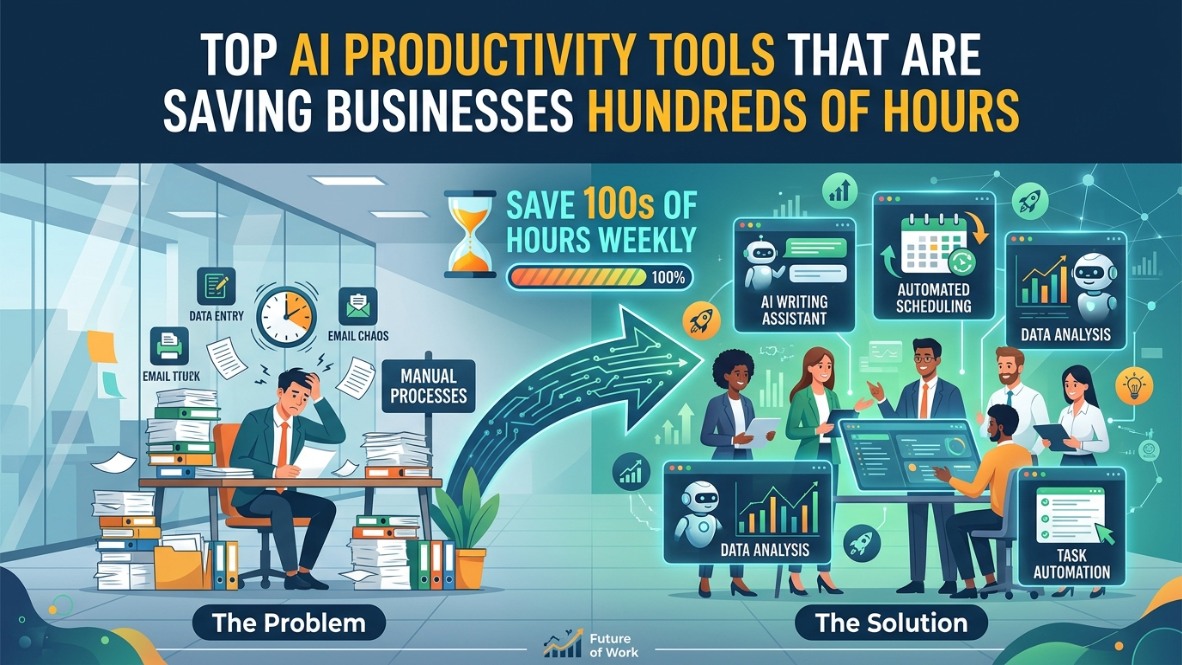
Artificial intelligence is no longer a future concept—it is now a core part of modern business operations. From automating repetitive tasks to improving communication and decision-making, AI productivity tools are helping companies reduce workload and save hundreds of hours every year.
Businesses today are under pressure to do more with less. Whether it’s handling customer support, managing data, or creating content, AI tools are becoming essential for improving efficiency and staying competitive in a fast-moving digital world.
In this article, we will explore the most powerful AI productivity tools in 2026 and how they are transforming the way businesses operate.
Why AI Productivity Tools Are Transforming Modern Businesses
AI productivity tools are designed to automate time-consuming tasks and improve operational efficiency. Instead of spending hours on manual work, employees can focus on strategy, creativity, and customer engagement.
Key benefits include:
- Automating repetitive tasks
- Improving workflow speed
- Reducing human error
- Enhancing communication
- Supporting better decision-making
- Increasing overall productivity
Businesses that adopt AI early often experience significant cost savings and improved output quality.
1. ChatGPT – AI-Powered Writing and Business Support
ChatGPT is widely used by businesses for writing, brainstorming, summarizing information, and automating communication tasks. It helps teams quickly generate content, draft emails, and create structured reports in minutes instead of hours.
Marketing teams, customer service departments, and business owners use it to streamline communication and reduce workload significantly.
2. Microsoft Copilot – AI Inside Everyday Work Tools
Microsoft Copilot integrates directly into Word, Excel, Outlook, and Teams, making it one of the most powerful workplace AI assistants.
It helps businesses:
- Generate documents automatically
- Summarize meetings
- Analyze data in Excel
- Create presentations quickly
- Draft email responses
Because it works inside existing tools, employees do not need to learn new systems, making adoption easier and faster.
3. Notion AI – Smart Knowledge Management System
Notion AI helps teams organize information, automate documentation, and manage knowledge efficiently.
Businesses use it for:
- Writing meeting summaries
- Creating project documentation
- Managing workflows
- Centralizing company knowledge
This reduces time spent searching for information across multiple platforms.
4. Grammarly AI – Faster and More Professional Communication
Grammarly AI improves written communication by correcting grammar, improving tone, and ensuring clarity.
It is widely used for:
- Business emails
- Reports and proposals
- Marketing content
- Internal communication
Instead of spending time proofreading, employees can focus on productivity and decision-making.
5. Jasper AI – Scaling Content Creation for Marketing Teams
Jasper AI helps businesses produce high-quality marketing content at scale.
It is commonly used for:
- Blog writing
- Social media posts
- Ad copy creation
- Email marketing campaigns
Marketing teams can generate content faster while maintaining consistency across channels.
6. Otter.ai – Automated Meeting Transcriptions
Meetings often consume time not only during discussion but also in documentation afterward. Otter.ai solves this problem by automatically recording and summarizing meetings.
It provides:
- Real-time transcription
- Meeting summaries
- Action item tracking
- Searchable conversation history
This allows teams to focus fully on discussions without worrying about note-taking.
7. Zapier AI – Workflow Automation Between Apps
Zapier AI connects different apps and automates workflows without coding.
For example:
- Sending leads to CRM systems
- Updating spreadsheets automatically
- Triggering email notifications
- Managing task creation
Automation like this saves businesses countless hours of manual work.
8. Fireflies.ai – Smart Meeting Intelligence
Fireflies.ai records meetings and extracts insights automatically.
It helps teams:
- Review meeting summaries quickly
- Track key decisions
- Store searchable conversations
- Improve collaboration
This reduces the need to rewatch meetings or manually take notes.
9. ClickUp AI – Smarter Project Management
ClickUp AI enhances project management by automating updates and organizing tasks efficiently.
It supports:
- Task generation
- Project summaries
- Workflow automation
- Progress tracking
Teams become more organized and productive with less manual input.
10. AI Customer Support Systems
AI-powered customer support tools are transforming how businesses handle inquiries. They can respond instantly to common questions and route complex issues to human agents.
Benefits include:
- 24/7 support availability
- Faster response times
- Lower operational costs
- Improved customer satisfaction
Real Business Example: AI + Service Efficiency
Even traditional service industries are benefiting from AI-driven efficiency improvements. For example, companies like Valderrama A/C & Refrigeration show how service businesses can combine operational expertise with modern digital systems to improve scheduling, customer communication, and service delivery.
Businesses in industries such as HVAC are increasingly adopting AI tools to improve customer response times, streamline booking systems, and enhance operational efficiency. Services like Valderrama A/C & Refrigeration reflect how traditional industries are evolving alongside digital transformation.
In fact, demand for hvac houston services continues to grow as businesses and homeowners prioritize fast, reliable climate solutions in extreme weather conditions.
Companies offering hvac services in houston are now also leveraging digital tools, automation, and AI-assisted workflows to improve scheduling, dispatching, and customer service efficiency.
How AI Tools Save Hundreds of Hours
When combined, AI productivity tools can save businesses significant time every month.
For example:
- Automated meeting notes save 5–10 hours/week
- AI content creation saves 10–20 hours/week
- Workflow automation saves 5–15 hours/week
- Customer support automation saves 10+ hours/week
Over a year, this easily translates into hundreds of saved working hours, allowing teams to focus on growth and innovation.
Choosing the Right AI Productivity Tools
To maximize results, businesses should consider:
1. Business Needs
Identify which tasks consume the most time.
2. Integration Capability
Ensure tools work with existing systems.
3. Ease of Use
Simple tools lead to higher adoption rates.
4. Scalability
Choose tools that grow with your business.
The Future of AI Productivity
AI tools are becoming more advanced, with future developments expected in:
- Predictive automation
- Smarter decision-making systems
- Industry-specific AI solutions
- Real-time business optimization
Businesses that adopt AI early will have a strong competitive advantage in efficiency and innovation.
Conclusion
AI productivity tools are revolutionizing the way businesses operate. From writing and communication to project management and customer support, these tools are helping companies save time, reduce costs, and improve overall efficiency.
Whether you are a small business or a large enterprise, integrating AI into your workflow is no longer optional—it is essential for staying competitive in 2026 and beyond.
FAQs
What are AI productivity tools?
AI productivity tools are software applications that use artificial intelligence to automate tasks and improve business efficiency.
How do AI tools save time?
They reduce manual work by automating repetitive processes like writing, scheduling, and data management.
Are AI productivity tools expensive?
Many AI tools offer affordable plans, including free versions for small businesses.
Can small businesses use AI tools?
Yes, AI tools are widely used by small and medium businesses to improve productivity.
What is the biggest benefit of AI productivity tools?
The biggest benefit is time savings, often resulting in hundreds of hours saved annually.
About the Author